

[Wuzhong Zhongchuang Control Valve] Sharing: Dynamic Diagrams and Classification of Commonly Used Control Valves
[Wuzhong Zhongchuang Control Valve] Pneumatic diaphragm control valves are mainly composed of linear stroke and angle stroke types.
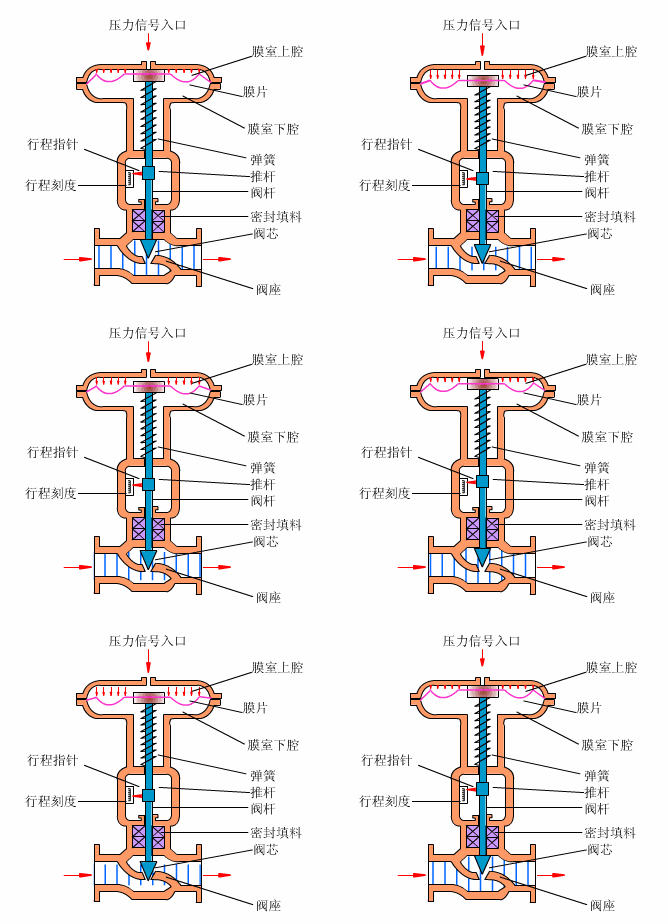
1. Linear stroke control valves:
⑴ Straight-through single-seat pneumatic diaphragm control valve
The pneumatic diaphragm single-seat control valve is a commonly used actuator in automatic control systems. It consists of a pneumatic diaphragm actuator and a straight-through single-seat valve. It features a single-seat plunger-type valve core with top and bottom guidance, simple structure, and reliable operation. The S-shaped streamlined channel minimizes pressure drop loss, provides large flow capacity, wide adjustable range, and high flow characteristic accuracy. The single-seat valve is suitable for applications requiring strict leakage control, low pressure differential across the valve, and media with certain viscosity and fiber content.
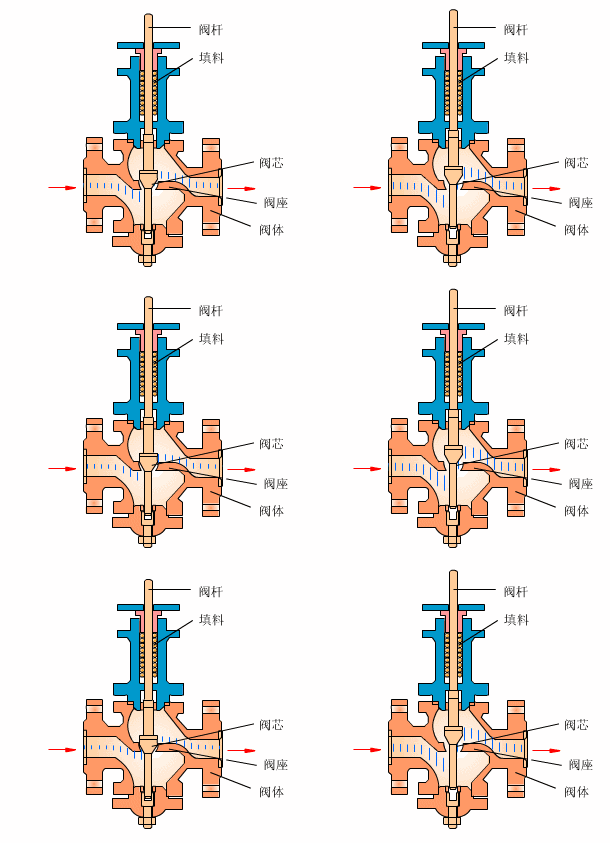
⑵ Straight-through double-seat pneumatic diaphragm control valve
Adopting a double-guided structure, the valve body is compact with an S-shaped streamlined fluid channel, featuring low pressure drop loss, large flow capacity, wide adjustable range, and high flow characteristic accuracy. With fixed guidance at both the top and bottom of the valve core, it offers vibration resistance and wear resistance. The control valve is equipped with a multi-spring diaphragm actuator, featuring compact structure and large output force, making it more suitable for excellent control under process conditions requiring good dynamic stability, high reliability, high pressure, high pressure differential, and fluid media containing sludge prone to blockage. The double-seat valve features small unbalanced force, large allowable pressure differential, and large flow capacity, making it suitable for applications where leakage requirements are not strict.
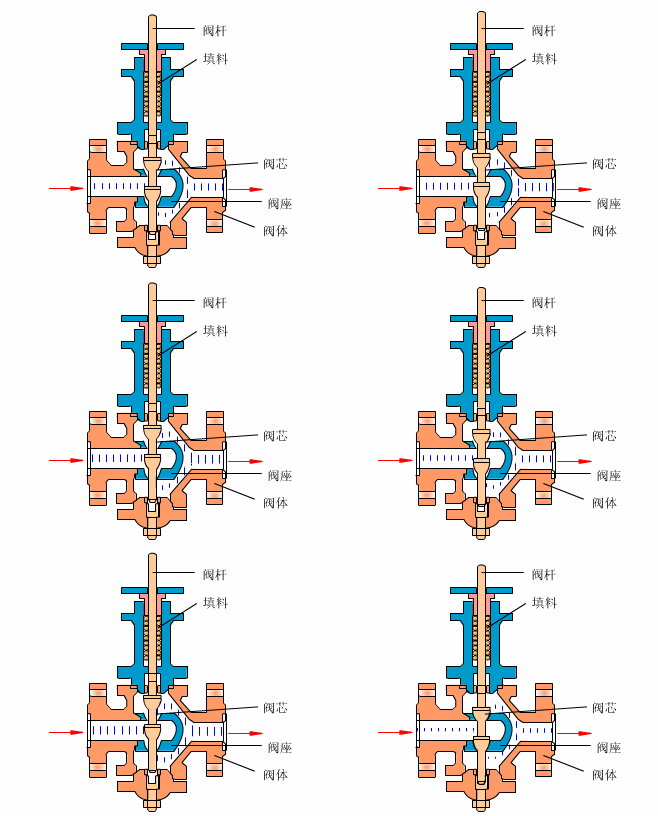
⑶ Straight-through sleeve pneumatic diaphragm control valve
The pneumatic diaphragm sleeve control valve is a pressure-balanced control valve. Equipped with a multi-spring actuator, the overall structure is compact, lightweight, and stable. The fluid passage is S-shaped streamlined with small pressure drop loss, large allowable pressure differential, low noise, and high flow capacity. It is widely used to control process parameters such as pressure, flow rate, temperature, and liquid level of media such as gas and liquid to maintain at given values. It is particularly suitable for occasions with large flow rate, large pressure differential, and less stringent leakage requirements. The sleeve valve has good stability, is not prone to vibration, has low noise, is less sensitive to temperature, and is suitable for occasions with large pressure differential and less strict leakage requirements.
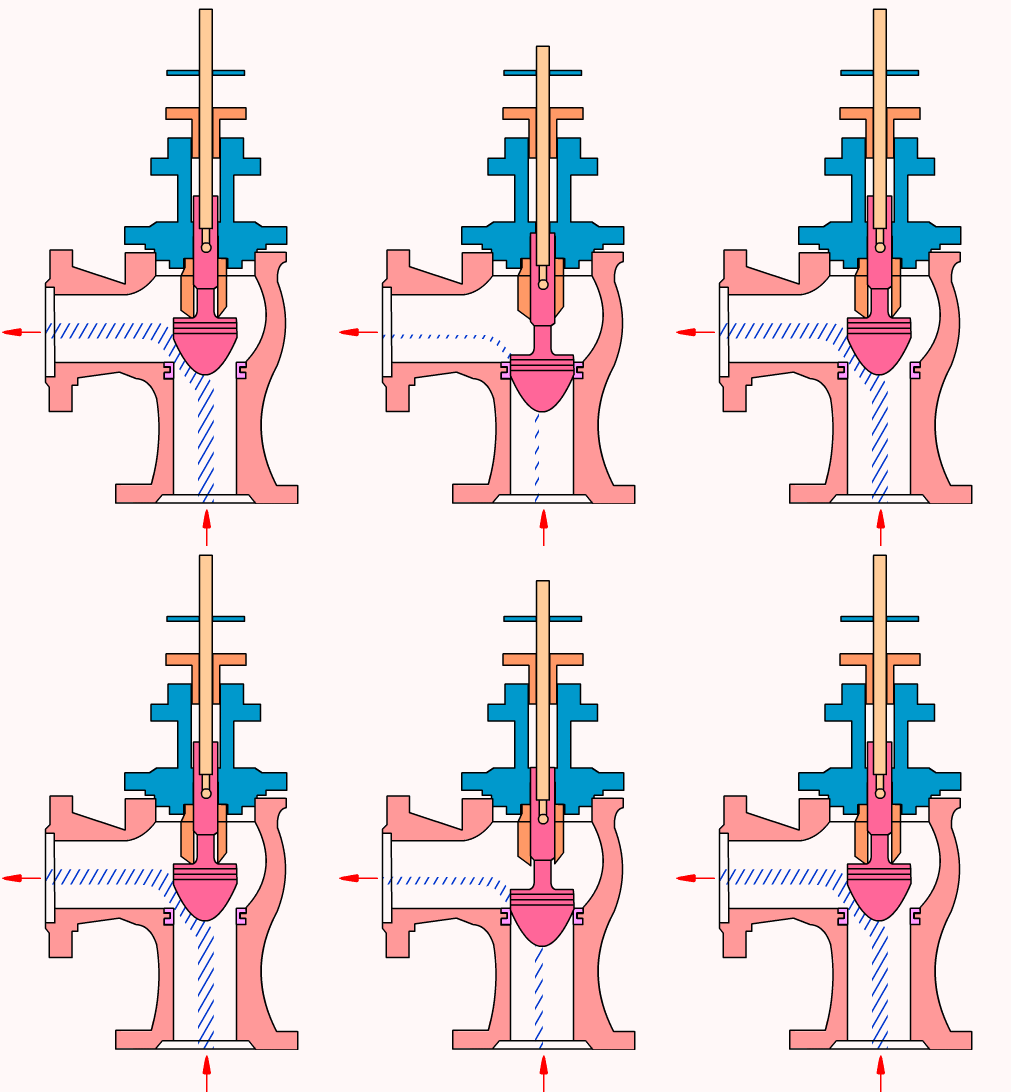
⑷ Angle Valve
The valve core moves linearly, and the two valve core centers form a right angle. The valve core adopts
a top-guided structure, the valve structure is compact, pressure drop loss is small, flow rate is large,
and the adjustable range is wide.
It is suitable for controlling fluids containing particles and slurry, viscous or flashing
fluids. It is mainly suitable for high pressure differential occasions.
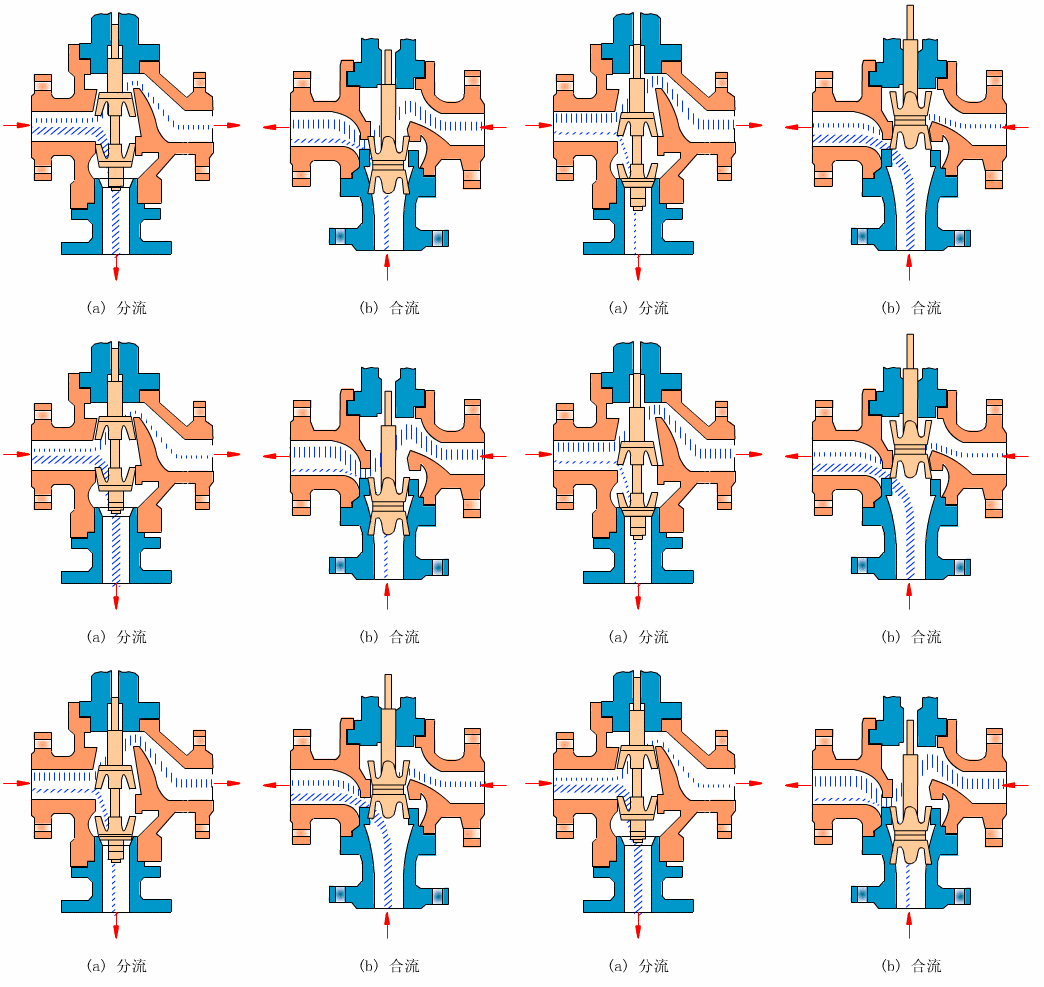
⑸ Pneumatic Diaphragm Three-way Control Valve
The three-way control valve adopts a cylindrical thin-walled window-type valve core guide and is equipped with a multi-spring actuator. It has the advantages of simple structure, light weight, small size, and convenient disassembly and assembly. It is widely used to control media such as gas and liquid, and process parameters such as pressure, flow rate, temperature, and liquid level to maintain at given values. It is suitable for dividing one fluid into two outlets through a three-way valve or merging two fluids into one fluid through a three-way valve. It is used for two-phase regulation of heat exchange and can also be used for simple
proportional regulation.
⒉ Rotary Control Valve
⑴ Butterfly Valve
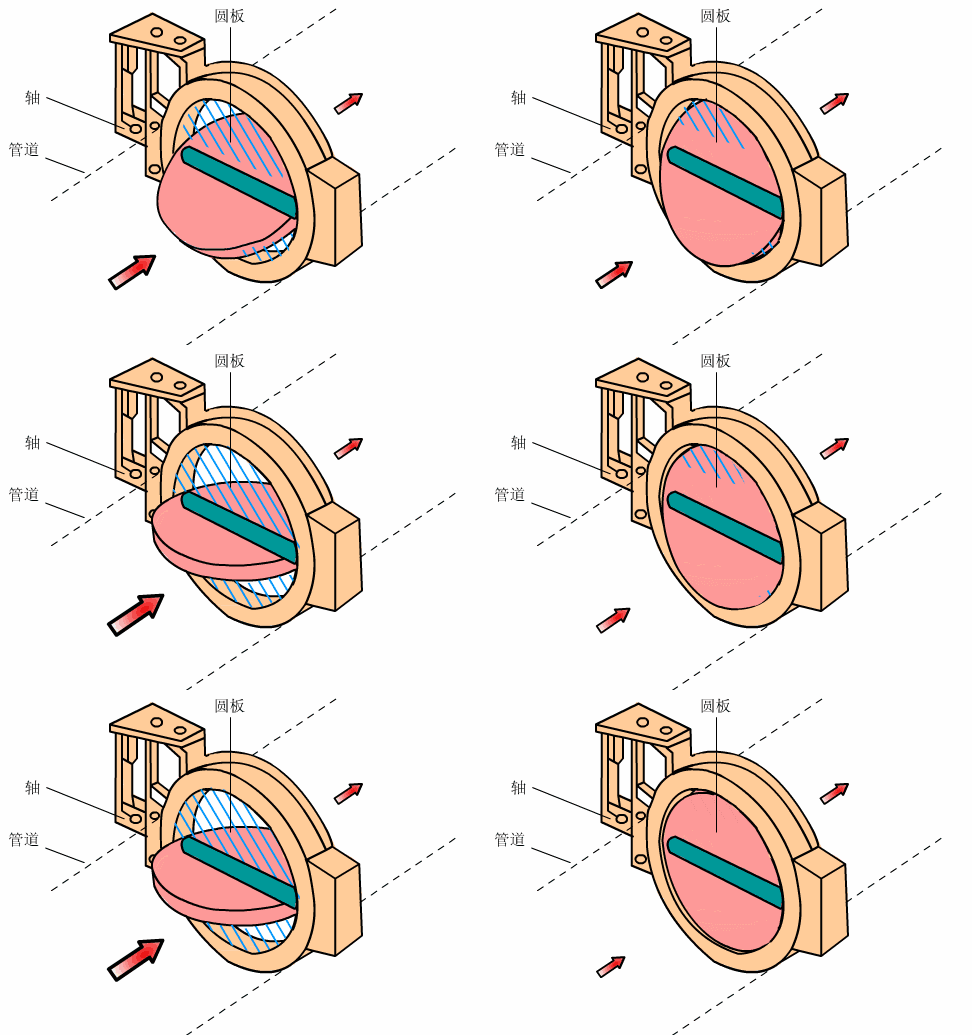
A butterfly valve is a type of valve that uses a circular disc as the closing element and rotates with the valve stem to open, close, and regulate fluid flow. The disc of the butterfly valve is installed in the direction of the pipe diameter. Inside the cylindrical channel of the butterfly valve body, the disc-shaped butterfly plate rotates around the axis at an angle between 0° and 90°. When rotated to 90°, the valve is in a fully open state. In the application fields of large and medium diameters and medium to low pressures, butterfly valves are the dominant valve type.
☆ Concentric Butterfly Valve
The structural characteristic of this type of butterfly valve is that the valve stem axis, disc center, and body center are in the same position. It has a simple structure and is convenient to manufacture. Common rubber-lined butterfly valves belong to this category. The disadvantage is that the disc and seat are always in a state of compression and scraping, resulting in high resistance and fast wear. To overcome compression, scraping, and sealing performance issues, the seat basically adopts elastic materials such as rubber or polytetrafluoroethylene, but this also limits its use in terms of temperature, which is why people traditionally believe that butterfly valves are not resistant to high temperatures.
☆ Single Eccentric Butterfly Valve
To solve the compression problem between the disc and seat of concentric butterfly valves, single eccentric butterfly valves were developed. Their structural characteristic is that the valve stem axis is offset from the disc center, so that the upper and lower ends of the disc are no longer the rotation axis, dispersing and reducing the excessive compression between the upper and lower ends of the disc and the seat. However, due to the single eccentric structure, the scraping phenomenon between the disc and seat has not disappeared throughout the entire opening and closing process of the valve. Its application range is similar to that of concentric butterfly valves, so it is not widely adopted.
☆ Double Eccentric Butterfly Valve
The double eccentric butterfly valve, which is currently the most widely used type, is a further improvement formed on the basis of the single eccentric butterfly valve. Its structural characteristic is that the valve stem axis is offset from both the disc center and the body center. The double eccentric effect allows the disc to immediately disengage from the seat after the valve is opened, greatly reducing unnecessary excessive squeezing and scraping between the disc and seat, reducing opening resistance, decreasing wear, and improving seat service life. The significant reduction in scraping also enables the double eccentric butterfly valve to use metal seats, enhancing its application in high-temperature fields. However, because its sealing principle belongs to positional sealing structure, that is, the sealing surface between the disc and seat is line contact, and the sealing effect is produced through elastic deformation caused by the disc squeezing the seat, the closing position requirements are very high (especially for metal seats), and the pressure bearing capacity is low. This is why traditionally people consider butterfly valves not resistant to high pressure and having large leakage.
☆ Triple Eccentric Butterfly Valve
To withstand high temperatures, hard sealing must be used, but leakage is large; to achieve zero leakage, soft sealing must be used, but it cannot withstand high temperatures. To overcome this contradiction of the double eccentric butterfly valve, a third eccentricity was applied to the butterfly valve. Its structural characteristic is that while the valve stem axis position is eccentrically offset as in the double eccentric design, the conical axis of the disc sealing surface is inclined relative to the body cylindrical axis. That is to say, after the third eccentricity, the sealing cross-section of the disc is no longer a true circle but an ellipse, and its sealing surface shape is therefore asymmetric, with one side inclined to the body centerline and the other side parallel to the body centerline.
The characteristic of this third eccentricity is that it fundamentally changes the sealing structure. It is no longer a position seal but a torque seal, that is, it does not rely on the elastic deformation of the valve seat, but relies on the contact surface pressure of the valve seat to achieve the sealing effect. Therefore, it solves the problem of zero leakage of metal valve seats in one fell swoop. And because the contact surface pressure is proportional to the medium pressure, high pressure and high temperature resistance are also easily solved.
⑵ Ball Valve
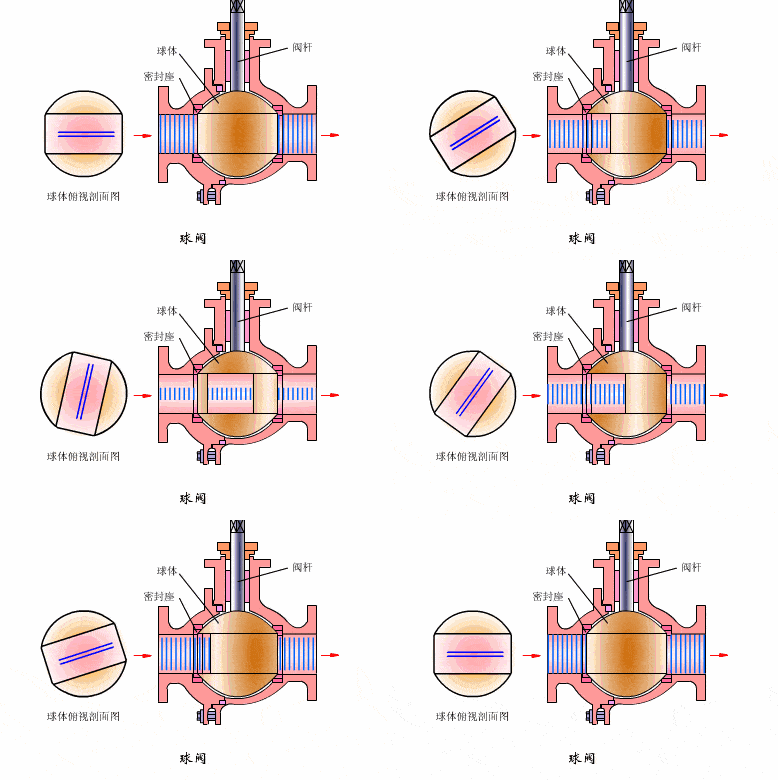
The pneumatic O-type quick shut-off ball valve is a rotary control valve with a rotation angle of 90°. It uses compressed air as the power source and receives switching signals from distributed control systems, programmable logic controllers, etc., and can achieve quick opening or closing of the valve through directional switching. It features compact structure, reliable operation, good sealing performance, large flow capacity, small flow resistance coefficient, long service life, easy installation, and bidirectional flow capability. The product is widely used in paper making, petrochemical, metallurgy, aerospace, food, pharmaceutical, water treatment and other industries. It is especially suitable for process control of high viscosity media and media containing fibers.
The pneumatic V-type control ball valve is a rotary ball valve whose core valve seat adopts metal-to-metal or metal-to-PTFE sealing configuration. It combines the control characteristics of ball valves and butterfly valves into one, and can be used both as a control regulating valve and as a shut-off valve.
⑶ Eccentric Rotary Valve
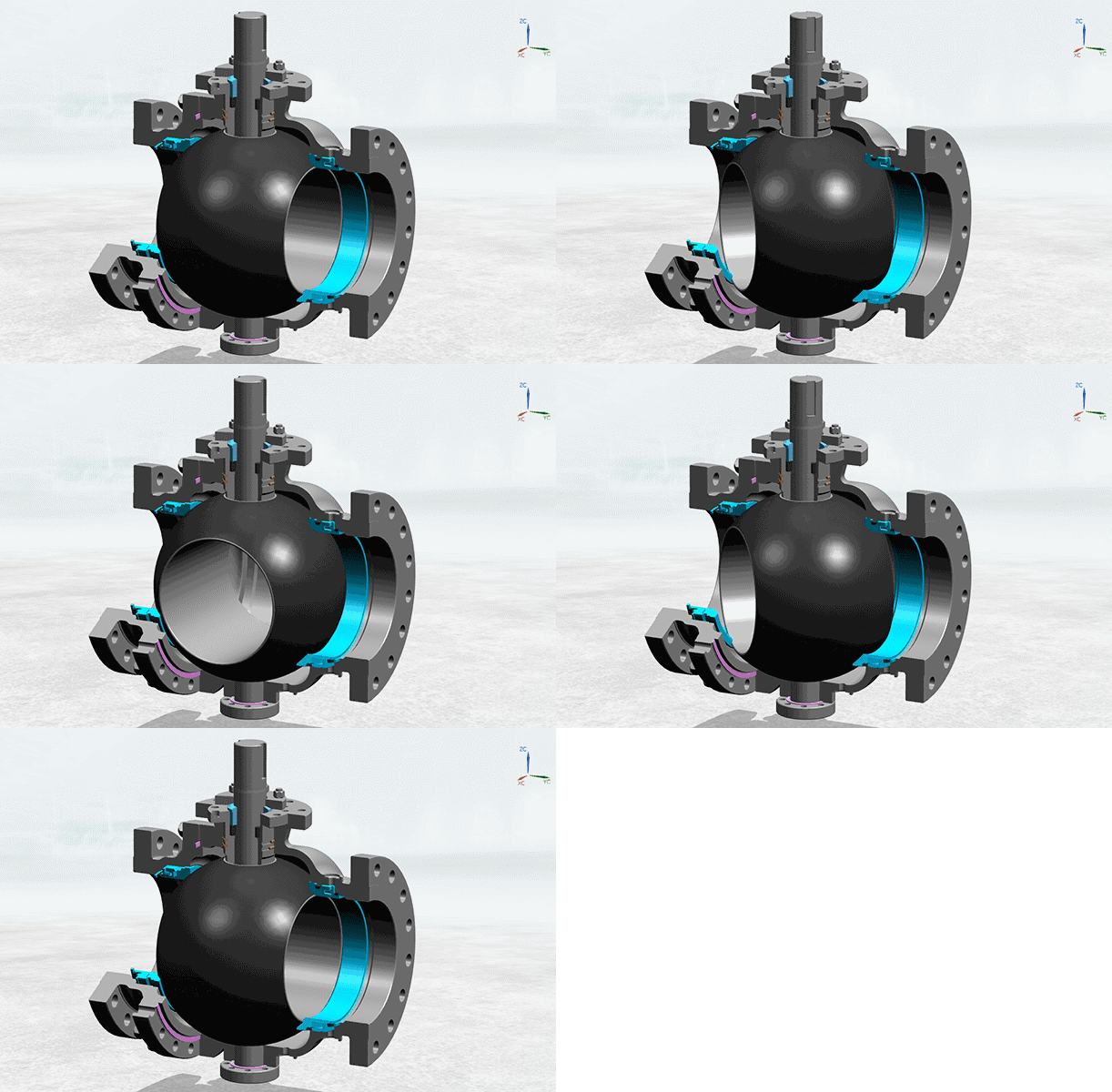
The pneumatic eccentric rotary valve is a through-type valve body structure with novel design and low fluid resistance. The rotation center of the valve core is not concentric with the rotating shaft, which can reduce valve seat wear and extend service life. A guide vane is installed at the rear of the valve core, which facilitates stable fluid flow and provides excellent stability. Meanwhile, it also features large flow capacity and wide adjustable range, making it particularly suitable for process system control containing slurry.